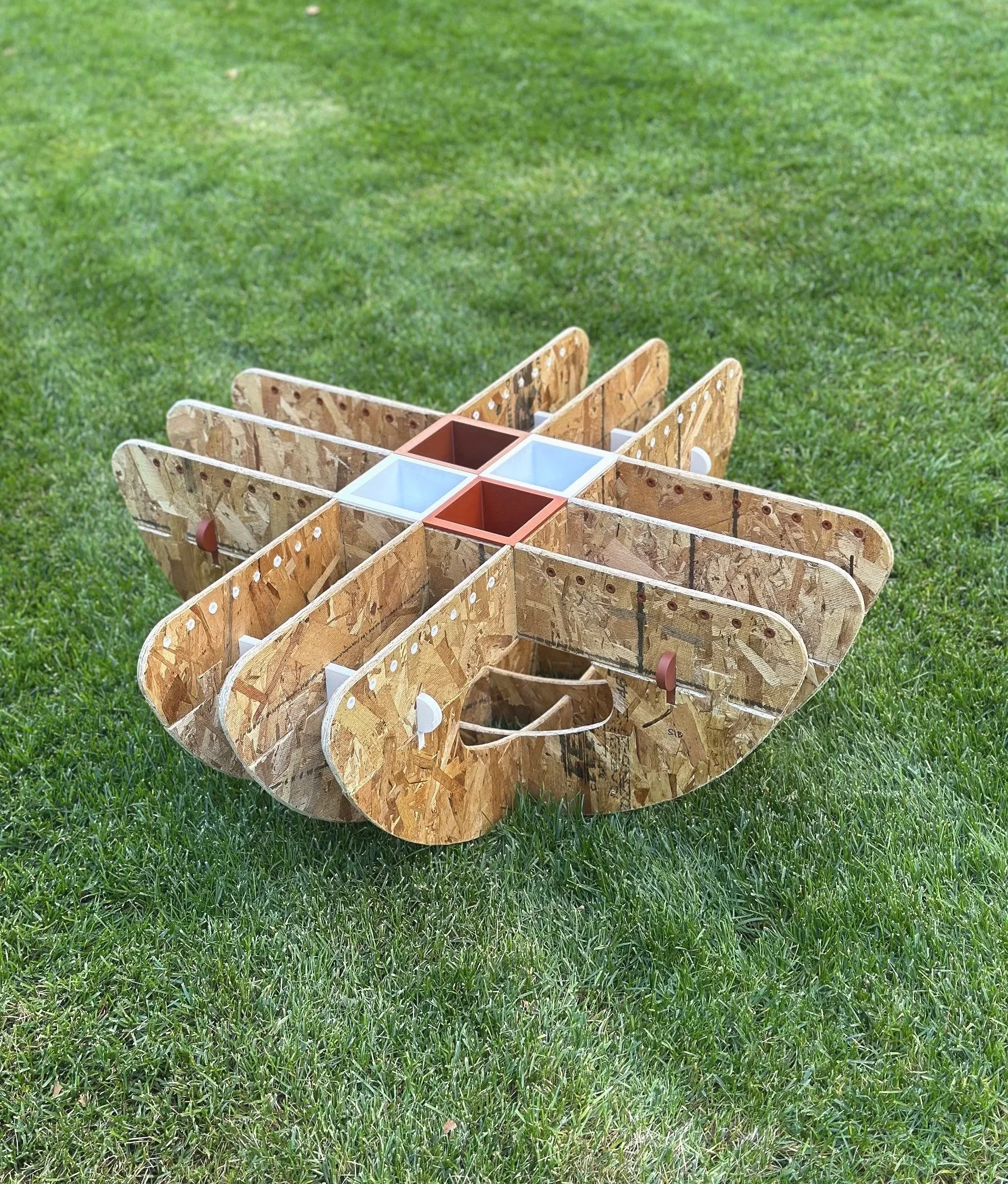
Wobbly Wobble
One week + One CNC machine + One material constraint = One very wobbly idea.
I wanted to challenge myself to build a four-way seesaw. Because why not?
Inspired by childhood rocker toys and dedicated to my fellow yappers in the studio, I set out to turn a single 4x8 ft sheet of oriented strand board (OSB) into something that could get four people talking, (semi) moving, and collaborating. The catch? Everything had to fit within one board while working around the material and machining constraints of CNC fabrication.
So, how might we make sitting around and yapping a little more collaborative?
Process details is also documented in my course page for ‘How to Make (Almost) Anything’.
-
How to Make (Almost) Anything / 2025
Course led by Neil Gershenfeld
-
Course led by Neil Gershenfeld
Thanks to Chris Dewart for setting me up on the CNC machinetion
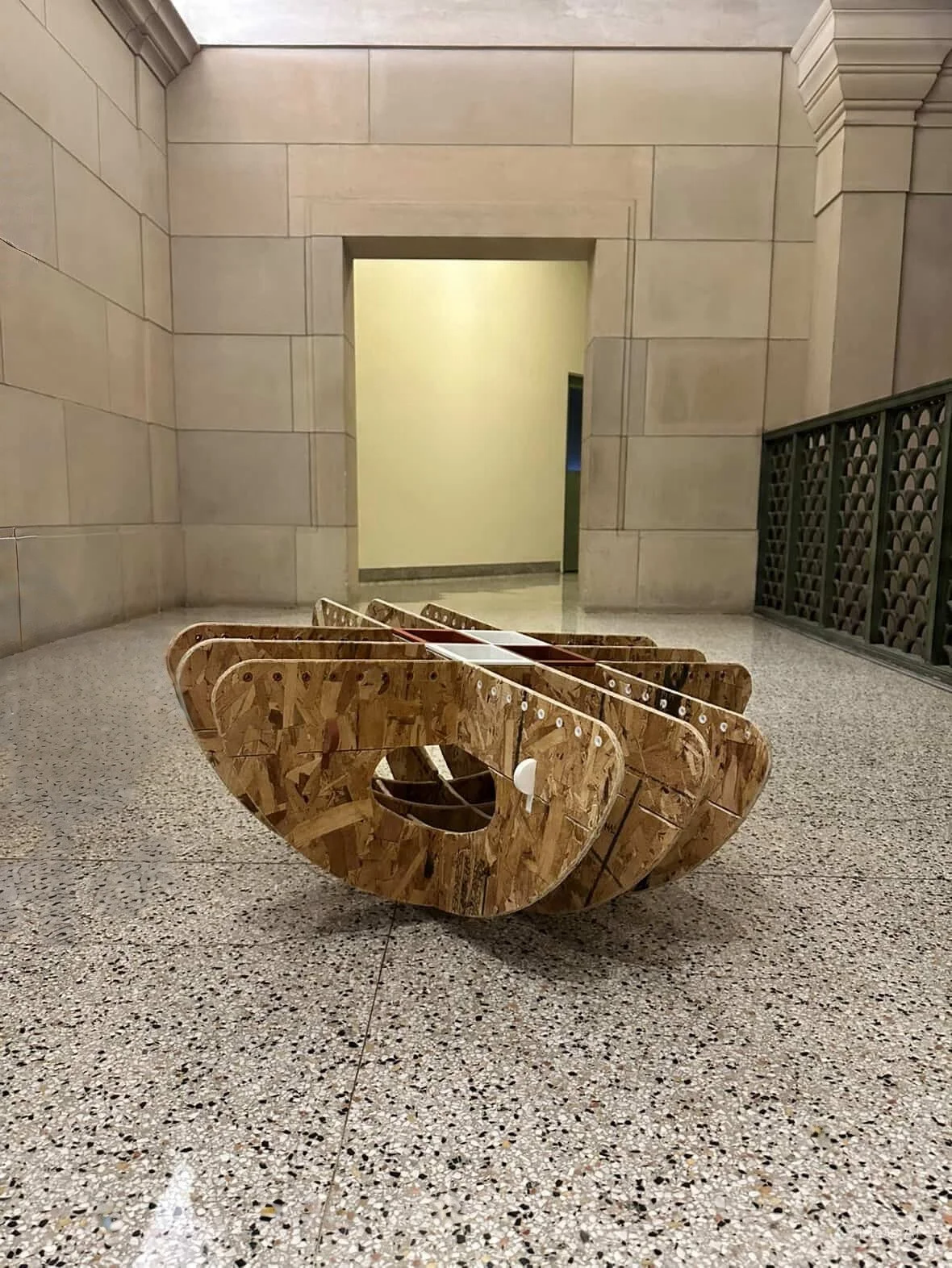
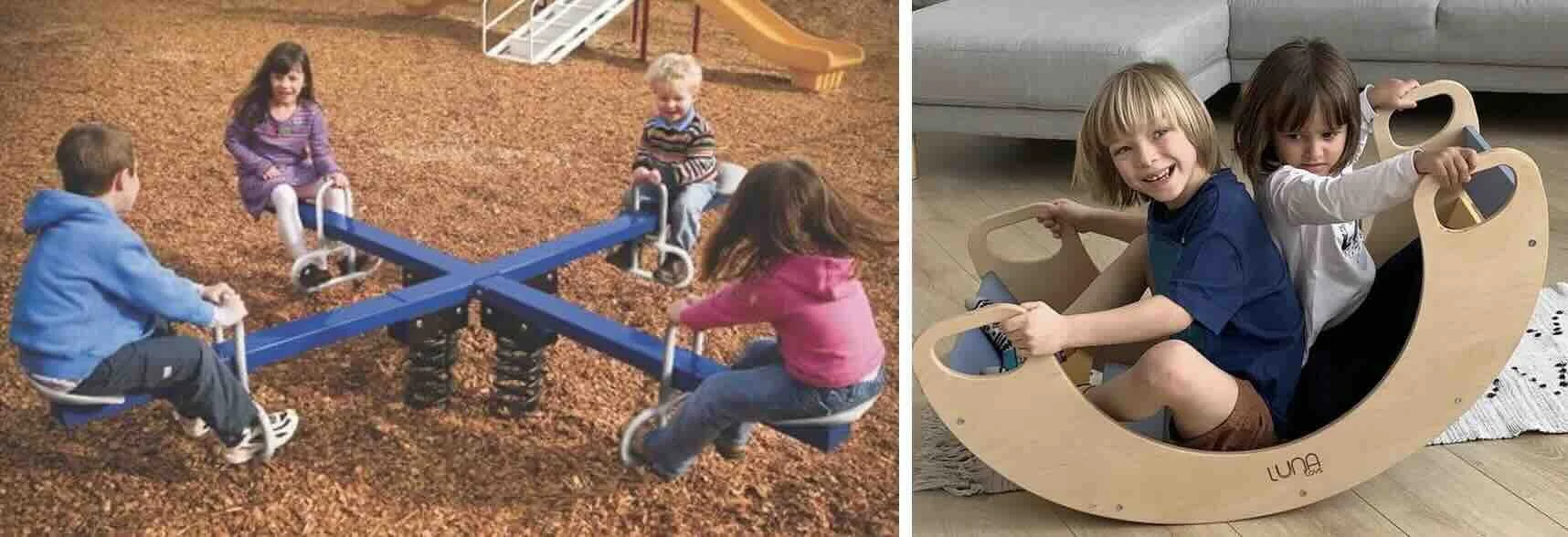
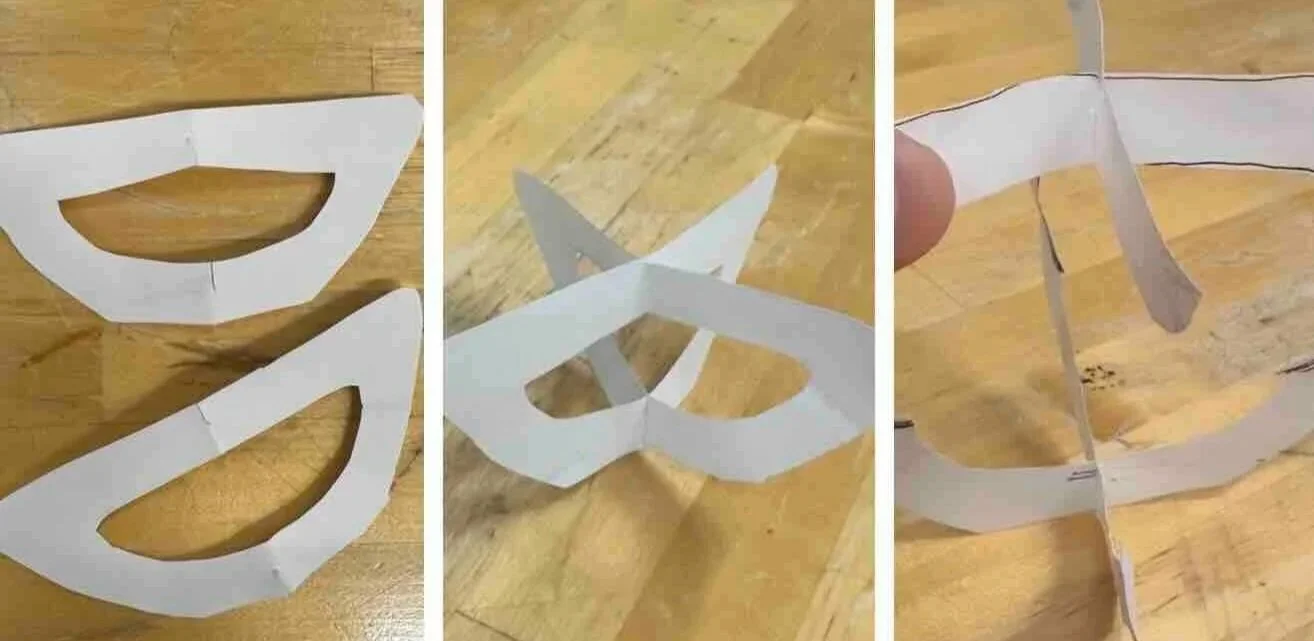
01 / / Concept: From See-saw to Wobble
Instead of the usual back-and-forth motion of a traditional seesaw, I wanted to explore a half-dome geometry that would allow four people to rock in multiple directions.
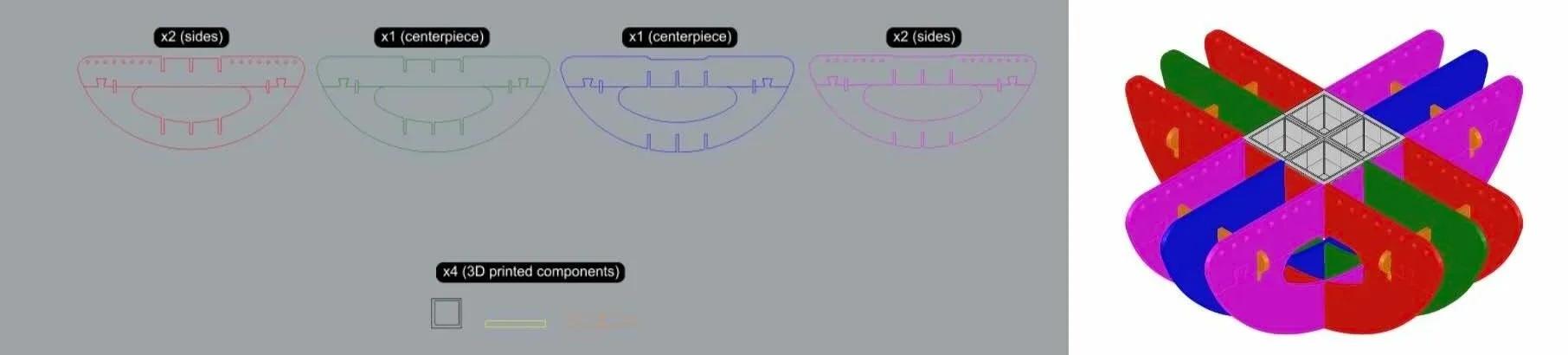
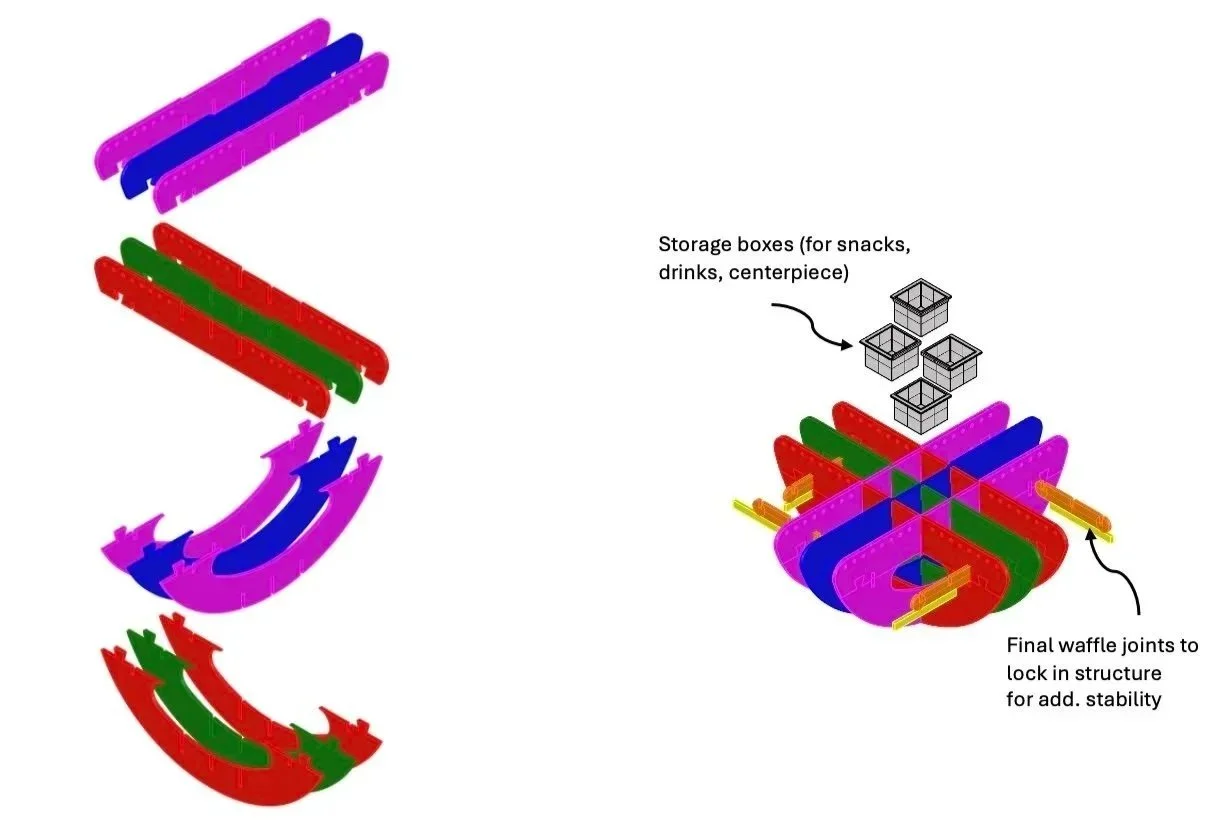
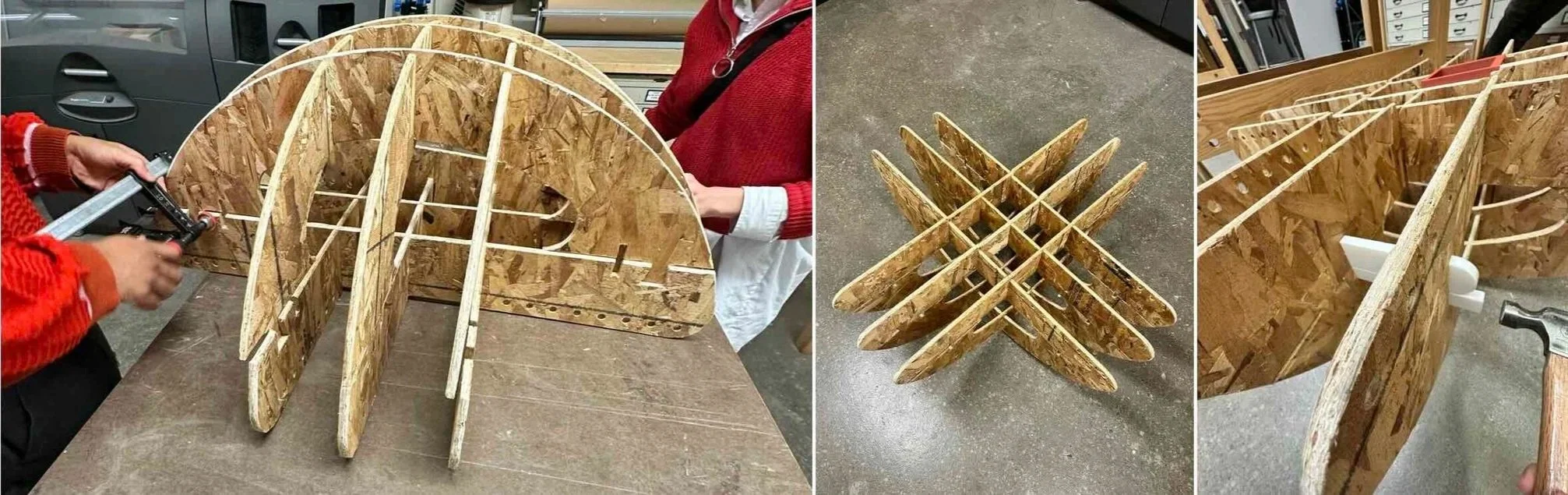
I started with quick paper models to explore the form and movement before refining the design in Rhino. The structure evolved into a series of interlocking ribs, divided into upper and lower sections to maintain symmetry and simplify assembly.
With only one 4 × 8 ft sheet of oriented strand board (OSB) to work with, every inch counted.
OSB is a cost-effective alternative to plywood for large-scale prototyping, but its tendency to chip and fracture meant I had to be mindful of joint geometry and material distribution. I designed the interlocking joints around the board's average thickness of 0.45 inches, relying on the material's slight flexibility to accommodate minor variations rather than introducing additional joint clearance.
More information about the process is detailed in my course page for ‘How to Make (Almost) Anything’.
02 / / Design Development & Fabrication
Typically, seating dimensions are at least 18 inches in both width and depth, with a seat height of around 18 inches for comfort. However, given the constraints of a single OSB board, I reduced each seat to 12 × 12 inches, with a height of 16 inches at its neutral position. As a result, the design serves as a scaled-down proof of concept for adult use (proportions more closer to children's furniture).
Next came the nesting puzzle: arranging all the components in Rhino to fit within a single board while maintaining sufficient spacing for CNC machining. I incorporated box joints, dovetails, and dogbone reliefs to accommodate the router bit and allow the components to interlock during assembly.
I also designed and 3D-printed reinforcing components to secure the four seating sections without forcing additional pieces through the chip-prone OSB. Some centerpiece box inserts also are incorporated that can double as phone (or snack storage), encouraging people to put their devices away and enjoy a little face-to-face interaction.
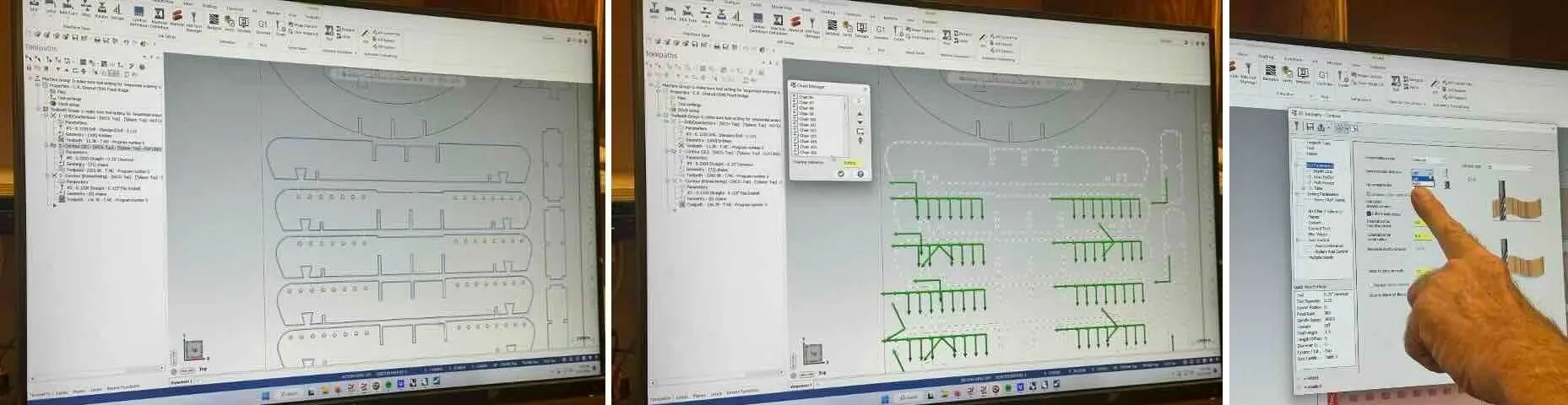
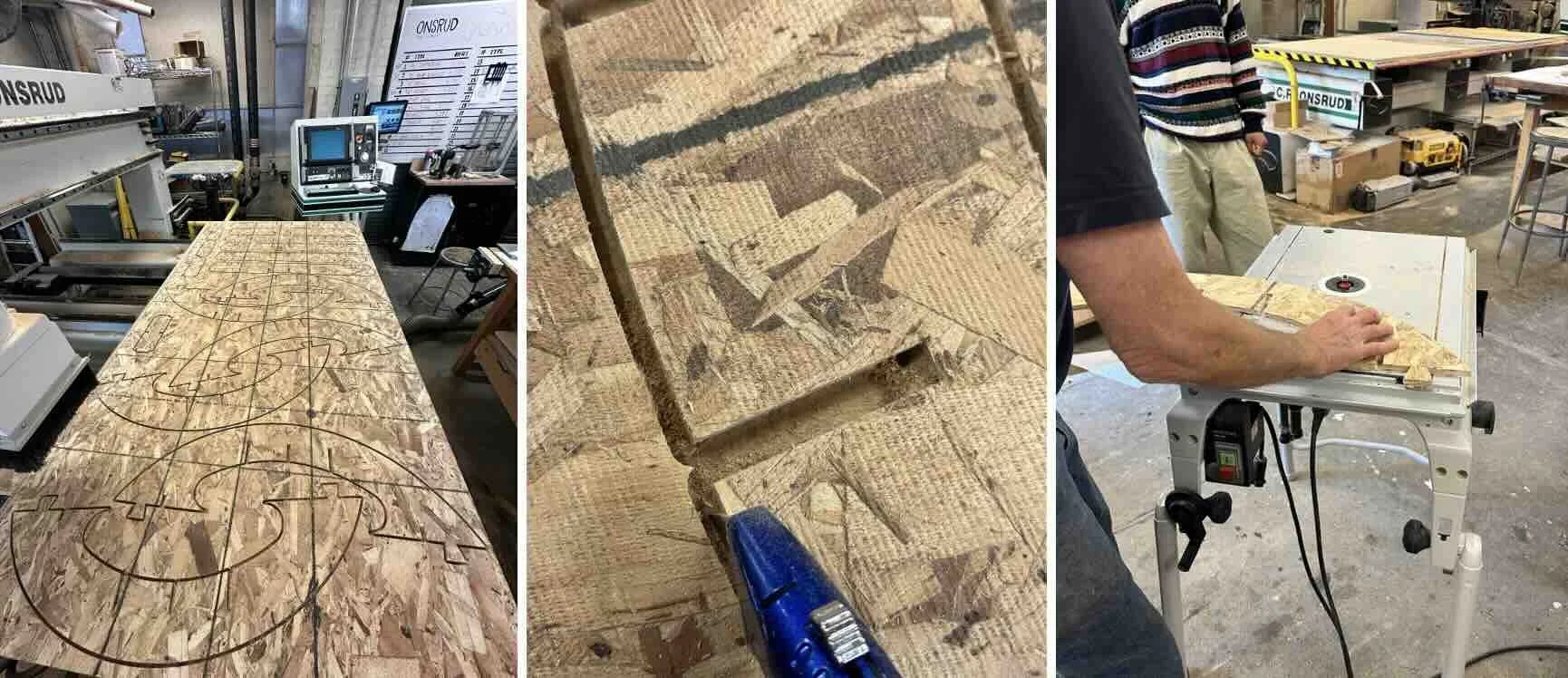
With guidance from Chris, our woodshop manager, I prepared the files for the Onsrud CNC router and learned how toolpath direction and onion-skin layers affect machining accuracy and part stability.
After milling, I cleaned up the remaining material and eased the edges with a handheld router.
03 / / Assembly & Play
Assembling the structure turned out to be the real test. With joints intersecting across the x, y, and z axes, aligning the upper and lower sections required a little more patience (and force) than anticipated.
The tight-fitting dovetails proved especially stubborn. Rather than sanding them down and risking a loose fit, I used pairs of clamps to gradually press the sections together without damaging the OSB. It was a simple adjustment that made all the difference.
The completed prototype brought together a playful concept and some very practical lessons in designing for assembly. The joints were quite snug and the top and bottom components had to be perfectly timed to mallet it together (thanks to my peers who saw me struggling and gave me a hand).
A little wobble was intentional. The assembly struggles? Not so much.
04 / / Reflection
Wobbly Wobble was a fun exercise in balancing playful design with material constraints, structural considerations, and the realities of fabrication. While this was only a rapid prototype, I'd love to revisit it at a larger, more ergonomic scale.
I imagine a future iteration using laminated plywood or steel for a sturdier frame, more comfortable seating, and a refined rocking geometry. The holes on either side of each seat were originally intended for threading ropes through to create amore comfortable, softer seating surface but at this scale, I decided to leave it out for the time being.
Ultimately, I'd like to see how far this wobbly idea could go as a functional piece of interactive furniture. After all, who says sitting around and chatting has to be stationary?